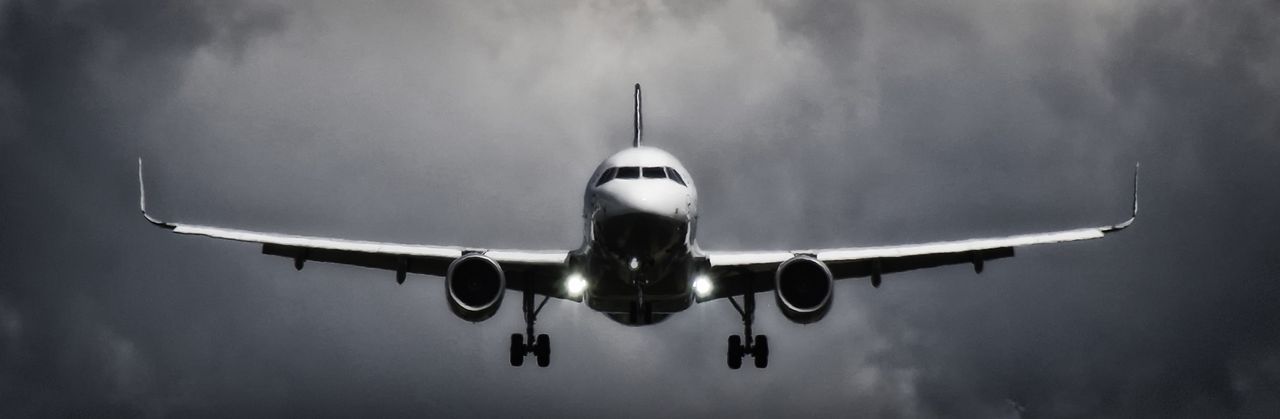
Annex 7 of the International Civil Aviation Organization highlights the minimum standards for the display of marks on aircraft to indicate nationality and registration. These standards were adopted pursuant to the provisions of Article 37 of the Chicago Convention on International Civil Aviation (1944) and became effective on the 1st of July 1949.
Annex 7 begins by defining common terms:
- Aeroplane: A power-driven heavier-than-air aircraft, deriving its lift in flight chiefly from aerodynamic reactions on surfaces which remain fixed under given conditions of flight.
- Aircraft: Any machine that can derive support in the atmosphere from the reactions of the air other than the reactions of the air against the earth’s surface.
- Airship: A power-driven lighter-than-air aircraft.
- Balloon: A non-power-driven lighter-than-air aircraft.
- Glider: A non-power-driven heavier-than-air aircraft, deriving its lift in flight chiefly from aerodynamic reactions on surfaces which remain fixed under given conditions of flight.
- Gyroplane: A heavier-than-air aircraft supported in flight by the reactions of the air on one or more rotors which rotate freely on substantially vertical axes.
- Heavier-than-air aircraft: Any aircraft deriving its lift chiefly from aerodynamic forces.
- Helicopter: A heavier-than-air aircraft supported in flight chiefly by the reactions of the air on one or more power-driven rotors on substantially vertical axes.
- Lighter-than-air aircraft: Any aircraft supported chiefly by its buoyancy in the air.
- Ornithopter: A heavier-than-air aircraft supported in flight chiefly by the reactions of the air on planes to which flapping motion is imparted.
- Remotely piloted aircraft (RPA): An unmanned aircraft which is piloted from a remote pilot station.
- Rotorcraft: A power-driven heavier-than-air aircraft supported in flight by the reactions of the air on one or more rotors.
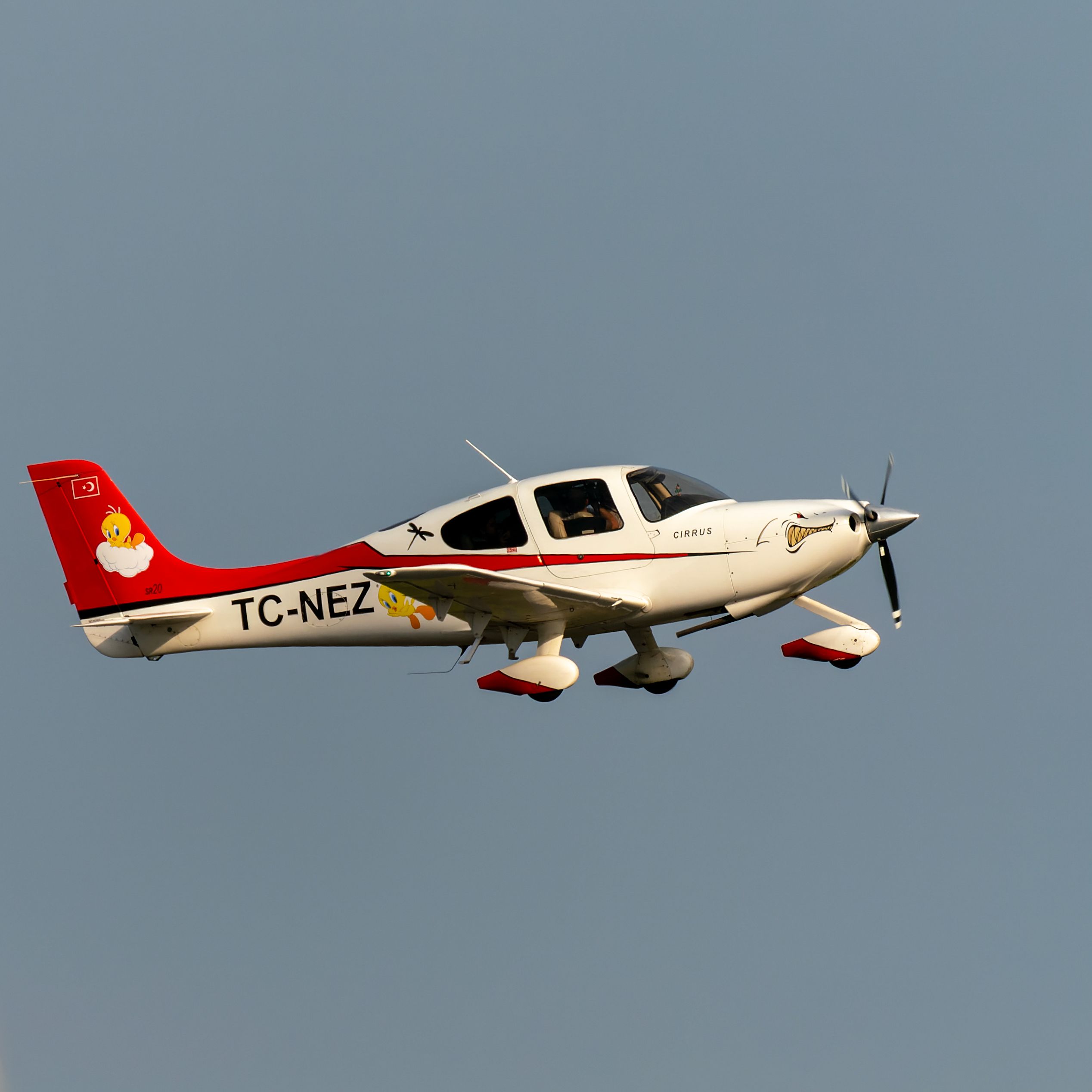
The nationality or common mark (assigned by ICAO to a registering authority of an international operating agency other than a national basis) and registration mark must consist of a group of characters. The nationality mark should precede the registration mark, and if the first character of the registration mark is a letter, it should be preceded by a hyphen.
The nationality mark is selected from the series of nationality symbols included in the radio call signs allocated to the State of Registry (state on whose register the aircraft is entered) by the International Telecommunication Union, ITU (a United Nations specialized agency for information and communication technologies, headquartered in Geneva, Switzerland). The common mark is selected from a series of symbols included in the radio call signs allocated to ICAO by the ITU. The registration mark consists of letters, numbers or a combination of the two, and is assigned by the State of Registry or common mark registering authority. The letter used should not have the following combinations:
- should not be similar to the five letter combinations used in the International Code of Signals, Part II
- should not be similar to the three letter combinations beginning with Q used in the Q code
- should not be similar to the distress signal SOS
- should not be similar to other urgent signals such as XXX, PAN or TTT.
The nationality and registration mark should be painted on the aircraft or affixed permanently, and should be kept clean and visible at all times.
The marks should be placed on the left half of the lower surface of the wing structure (left wing), equidistant from the leading and trailing edges of the wing, and the top of the letters and numbers should face toward the leading edge of the wing. The marks should appear either on each side of the fuselage, between the wings and the tail surface, or on the upper halves the vertical tail surfaces. Regardless, for an aircraft that does not have these parts, the marks should be placed in a manner such that the aircraft can be identified readily.
All letters and numbers used in registration should be of equal height. On the wings, the height of the marks should be at least 50 centimetres. On the fuselage and vertical tail surface, the height should be at least 30 centimetres. On aircraft that are too small, these dimensions will be determined by their State of Registry. The letters should be Roman characters in capital letters, and the numbers shall be Arabic numbers. Both letters and numbers should have no ornamentation. The width of each character (except letter I, and number 1) and the length of hyphens should be two-thirds the height of a character. The characters and hyphens should be formed by solid lines and should be of a colour contrasting clearly with the background. The thickness of lines should be one-sixth the height of a character. The spacing between characters, including the hyphens, should not be less than one-quarter of a character’s width.
Every aircraft should carry an identification plate inscribed with at least its nationality or common mark and registration mark. the plate shall be of fireproof metal or other fireproof material (capable of withstanding heat as well as or better than steel when the dimensions in both cases are appopriate) of suitable physical properties. The identification plate should be secured to the aircraft in a prominent position near the main entrance.
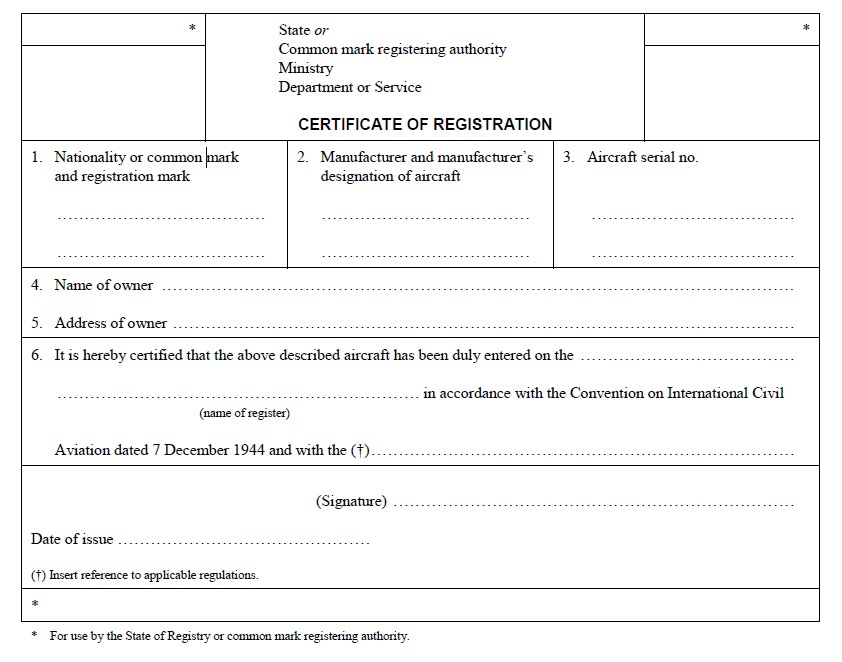
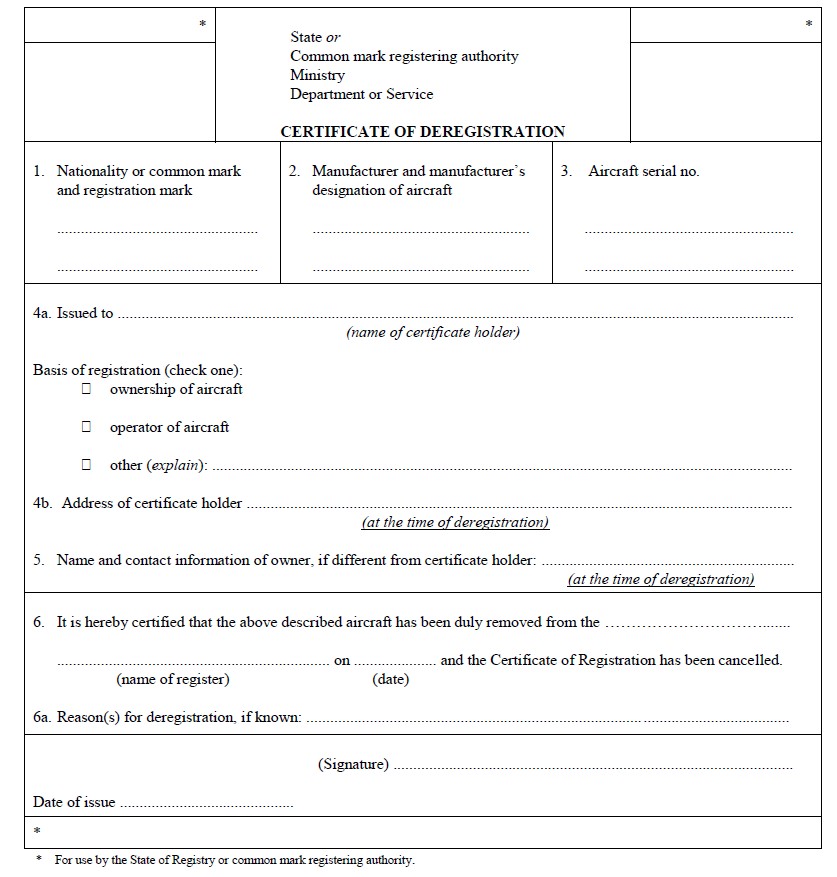
Every contracting state or common mark registering authority should maintain a current register showing all the information captured in the Certificate of Registration for all aircraft registered. The Certificate of Registration, and Certificate of Deregistration should be issued in English, or include an English translation if it’s not issued in English.
Note that the above provisions are not exhaustive under Annex 7.
The Annex also lists provisions for registration and marking of lighter-than-air aircraft, which are not listed above.